







今ご注文頂くと、最短で9/14(Mon.)に発送します

Behind the scenes of making the ZUTTO original jubako (stacked lacquer boxes) at a kiji (wood base) workshop in Fukui Prefecture, a region known for its urushi (Japanese lacquer) craftsmanship.

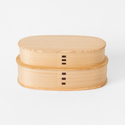
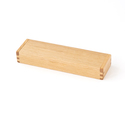
The rectangular two-tiered jubako from ZUTTO has been well received since it went on sale. It's a jubako that came together through careful thought and ingenuity, designed to be shaped for everyday use.

>>Click here to learn more about this product

This installment of our reading series is a special edition, a report on our visit to Inoue Toku Mokkou, the kiji-ya (wood base workshop) that actually made these jubako for us. Our staff traveled all the way to the workshop in Sabae City, Fukui Prefecture, and had the very valuable experience of witnessing the craftsmanship up close.

A visit to the workshop as autumn deepened

We visited on a day at the end of October, as autumn had settled in.

The Kawada district in Sabae City, Fukui Prefecture, is a region where not only urushi ware but also eyeglass-making thrives, and many workshops are clustered here. Right near Inoue Toku Mokkou are companies that ZUTTO has also worked with, such as Rokurosha and Taniguchi Megane's tesio.

Stepping inside the workshop, a gentle scent of wood filled the air. A few people were each quietly working on their own tasks, with no loud noises—an overall calm atmosphere.

Inoue Toku Mokkou is a workshop that mainly produces the kiji (wood base) for "kakumono," the foundation of Echizen lacquerware. Kakumono refers to box-shaped items such as jubako, trays, and small boxes. This is the place where boxes are shaped from wooden boards, before any urushi or other coating is applied.

▲Mr. Inoue, who guided us through the workshop.

First, he explained the process by which a box takes shape.

【1. Kidori (Timber Selection and Cutting)】

Appropriate wood is selected according to the product being made, and large pieces of timber are cut into boards. Apparently, they used to purchase the wood already in board form, but now they keep large blocks of timber in storage and cut them to the appropriate size each time as needed. This reduces wasted wood, and reflects the kind of flexible, hands-on approach typical of a workshop where craftsmen work directly with their hands.

【2. Buzai Kakou (Parts Processing)】

Before assembly, each part is shaped using machines and hand tools. On this day, we were shown a machine that cuts the wood at a 45-degree angle. This is the tome-tsugi (mitered joint) processing that Inoue Toku Mokkou specializes in.

▲The mechanism allows the blade's angle to be adjusted.

This machine has a scale for adjusting the angle, but simply matching it to the markings isn't enough. The craftsman checks by eye and makes fine adjustments by hand during processing.

▲Even the slightest deviation prevents a clean right angle, so the finishing is done with great care.

A corner is formed from two boards. It's a very simple structure—two pieces cut at 45 degrees and joined together—but that simplicity is precisely why such high precision is required.

【3. Kumitate (Assembly)】

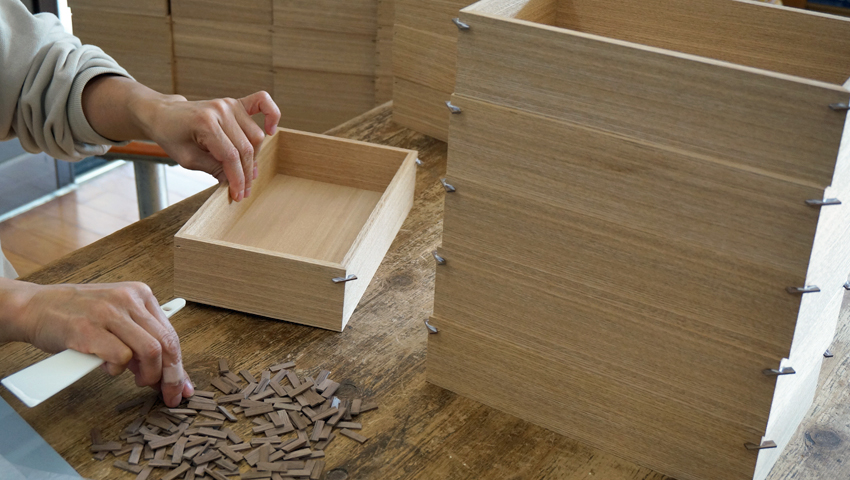
The completed parts are assembled into the shape of a box. On this day, the jubako we saw was in the process of having wedges glued into the corners, part of this assembly step.

One by one, wedges are fitted into the corners entirely by hand.

【4. Shiage (Finishing)】

Finally, the whole piece is checked over, and the kiji is complete. In this case, since no urushi is applied and the natural wood grain remains visible, the quality of the fine details has an even greater impact on the finished piece.

Once the box takes shape this way, it moves on to the coating workshop. Kakumono production is done through a division of labor, and it took about a month for this jubako to reach completion—passing through the hands of many different craftsmen along the way.

The area where the wood is processed forms one large space, lined with multiple machines used for each step of the process.

Passing through this space, we found a storage area for wood further inside.

In this dark, cool space, several large wooden boards were stored.

It looks like there are many different types of wood, but in reality there are only about five species. The species chosen differs depending on whether the wood will be used as a base for lacquerware or finished clear, as in this case. The Hokuriku region, which includes Fukui Prefecture where the workshop is located, is humid year-round, unlike the "dry winters" typical of the Pacific side of Japan. Because of this, the wood must be stored with constant attention to humidity throughout the year.

"Because of these differences in climate, sometimes a piece that was perfectly fine at the workshop can warp or otherwise lose its shape after delivery, due to the added dryness of heating. If that does happen, please rest assured that we'll consider whatever repair options might be possible—but we'd also ask that you take care to avoid drying from heating."

On the second floor, there is also a room where every prototype made over the years is kept. The sheer number was overwhelming, as if it held within it the entire history of Inoue Toku Mokkou since its founding.

A clean, modern jubako.

We also asked about the specifications of this original jubako.

What is an inrobuta?

"An inrobuta (inro-style lid) is also known as an aikuchigata. There are other types too, such as the 'itabuta,' which is simply a single flat board placed on top, or the 'kabusebuta,' which is made larger than the body and fits over it like a cap.

With this inrobuta, the sides stay flat, giving the cleanest possible appearance. Where the body and lid fit together, the wood is carved out, which takes extra time and effort. There's also the advantage that since the lid sits higher than the box itself, food is less likely to touch the underside of the lid."

Wedged miter joints that combine both function and design

"These wedges are attached to keep the box from coming apartで、元々機能を持ったものです。ただ、今回本体の明るいタモ材に対して色の濃いウォールナットをあわせたのは装飾の意味合いで選びました。」 This part should be translated too. Let me redo it properly. --- "...and originally it served a functional purpose. However, this time we chose to pair the dark-colored walnut with the light-colored tamo (Japanese ash) of the main body for decorative reasons."

▲The wedge catches your eye when it's set on the dining table, giving it a wa-modern (Japanese-modern) impression.

Why Tamo Wood

"Tamo (Japanese ash) is characterized by its natural, pale color and its beautifully even, clearly visible grain. For a clear finish like this one, the color and beauty of the grain matter most, so we chose tamo."

"If we were applying urushi (Japanese lacquer), we'd choose a wood with an even smoother surface than tamo. Wood that shrinks easily also isn't suitable. Since suitability varies depending on the finish, we select materials while drawing on our past experience."

Urethane Coating for Everyday Ease of Use

"I think urethane coating isa finish that's very well suited to everyday use. Making the boxes for this jubako (tiered lacquer box) took two weeks, and coating took another two weeks, for a total of about a month. The coating isn't applied just once and finished—we apply it, let it dry, and repeat this many times over, then store the piece until the coating's smell fades before shipping it out."

"If you're concerned about the smell before using it,please leave it in a well-ventilated spot out of direct sunlight.The smell will naturally fade away."

Q&A on How to Use It

Q1. Is there anything I should be careful about when using it?  

"As I mentioned earlier, to avoid drying it out, please avoid placing it somewhere that gets direct airflow from an air conditioner or direct sunlight, but since it has a urethane coating, no special care is needed. Please feel free to use it casually.

After use, just wash it with a neutral detergent on a soft sponge, the same as you would with ordinary dishware. However, please don't use a dishwasher, as it can cause the wood to crack or warp."

Q2. Is it okay to let it air-dry naturally?

"It's fine to turn it upside down in a basket or colander and let it air-dry while draining. There's no particular need to quickly wipe away water droplets. The things to watch out for are avoiding soaking it in water for long periods, or drying it in front of a heater."

Q3. Can it be repaired?

"If anything comes up that concerns you as you use it, we'll repair it as best we can. What can be done varies case by case, so we'd propose a solution after checking the actual piece."

*If you'd like a repair, please contact ZUTTO Customer Support.

A few weeks after this interview, the rectangular two-tiered jubako finally arrived at the ZUTTO warehouse. Learning what goes on behind the scenes of making something makes you feel even more attached to it. All of us on the ZUTTO staff are looking forward to our customers using it.

▼The rectangular two-tiered jubako can be found here

▼The original azuma bukuro (wrapping cloth bag) made to go with the jubako can be found here

投稿者: ZUTTO編集部 日時: 2022年12月11日 11:00 | permalink

閉じる