




.jpg)














.jpg)

.jpg)
.jpg)




- トップページ/
- ZUTTO Journal/
- お手入れ・エイジング/
- Material Care Enc...

Material Care Encyclopedia"Stainless Steel"
Table of Contents)
・How to Handle StainlessSteel Items
・List of Stainless Steel Cookware Brands
What is Stainless Steel
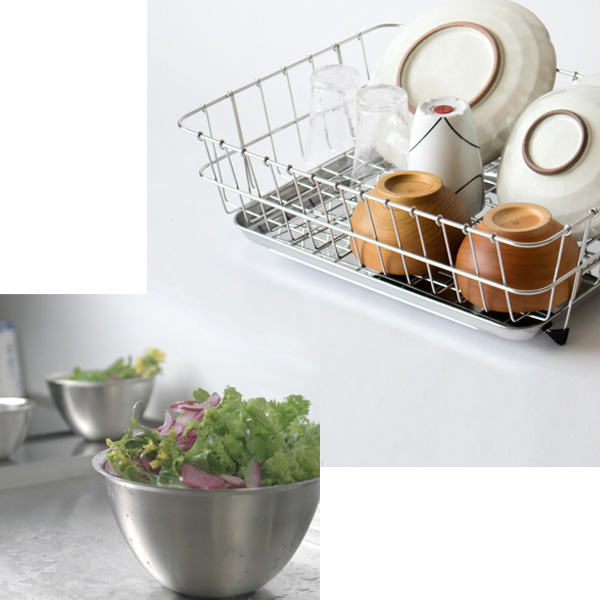
The name "stainless" is said to come from the fact that it doesn't rust easily, and true to its name, it's highly resistant to rust and easy to care for, which is why it's so often used for items around water. Its main components are alloys such as iron and nickel, and unlike plastic, it doesn't deteriorate over time, making it an excellent material choice for tools meant to last for years. Thanks to this rust resistance and its strength against acids as well, many kitchen tools are made of stainless steel—kitchen shears, knives, lemon squeezers, peelers, graters, storage containers, kettles, bento boxes, bowls, and colanders, to name a few.
About the Material
Every material has its strengths and weaknesses, and stainless steel is no exception. Here are some of its good points and its more difficult aspects.
❶Highly corrosion-resistant and rust-resistant.
❷Highly heat-resistant, said to withstand temperatures up to around 500°C without affecting its properties. (It's also used as the inner material of familiar items like water bottles and thermoses.)
❸Sturdy and not easily broken.
❶It has a property called work hardening, meaning that once it's bent, it's difficult to reshape.
❷Heat doesn't spread evenly across the surface, so scorching happens easily.
While it's true that stainless pots scorch easily, this can be worked around with a little extra effort—for instance, when sautéing ingredients before simmering them, you can cook them in a separate frying pan first and then transfer them to the stainless pot, so they don't stick and burn.
How to Handle Stainless Steel Items
When You First Start Using It
Due to the manufacturing process, fine debris such as iron particles may sometimes cling to the surface. For cookware, it's safest to wash it thoroughly with dish soap and a sponge, then rinse well. You can also remove finer impurities by boiling the item in rice-rinsing water or with vegetable scraps, or by boiling water with a bit of vinegar added.
Things to Avoid
・Since grilling or sautéing directly on stainless steel can cause scorching, it's best to avoid this. For example, when preparing curry or stew that requires sautéing before simmering, it's recommended to do the sautéing in a frying pan first, then transfer everything to the stainless pot to simmer.
・If stored in contact with cooking utensils or containers made of a different metal, the point of contact may rust.
After Use
・There's nothing especially tricky about care, but if food or oily items are left inside for a long time, rust can occasionally develop.
・Be careful not to overdo it with sponges or steel wool that are too abrasive, as they can scratch the surface.
・Rust can be caused by leftover moisture, so be sure to dry items thoroughly before putting them away.
When You Run Into Trouble

◆If You've Scorched Something
1. First, soak the pot in hot water to soften the scorched residue.
2. Leave the pot for about 10 minutes, then scrub it with a sponge.
3. If the scorching doesn't come off with a sponge, try scrubbing gently with a wooden or bamboo spatula, which won't scratch the surface.
4. Do not use hard metal tools, as they will scratch the surface.
◆If Scrubbing With Hot Water or a Spatula Doesn't Work
Fill the pot with lukewarm water, add about 2 tablespoons of vinegar or citric acid, and let it sit for a while. After about an hour, discard the water and rinse the pot clean. For stubborn scorch marks that still won't come off, heat the pot over low heat for about 15 minutes, then let it sit for about half a day and check on it.
◆For Truly Stubborn Scorching
Use a nylon scouring pad, which is harder and rougher on the surface than a regular sponge. This may leave minor scratches on the pot's surface, but small scratches won't affect its use—we recommend working on the smallest area possible and taking it little by little.
◆If Rust Has Formed
Apply cream cleanser to a sponge and scrub the rusted area. Baking soda or a melamine sponge can also be used as a substitute.

◆If Red Spots Appear
Red spots come from iron and other minerals in water sticking to the surface. Fill the container with lukewarm water containing about 10% vinegar, let it sit for 30 minutes, and then thoroughly wash the inside of the inner bottle with a soft sponge.
◆If White, Gritty Deposits Form on a Kettle
These deposits come from calcium and other minerals in the water. Fill the kettle with lukewarm water containing about 1–2% citric acid, let it sit for 3 hours, and then thoroughly wash the inside of the inner bottle with a soft sponge.

◆If Rainbow-Colored Discoloration Appears
Add citric acid or vinegar—if it's a pot, bring it to a boil. If it's a water bottle, pour in boiling water and let it sit for a while; the rainbow-colored areas will clear up.

How to Sharpen a Kitchen Knife
Among stainless steel cooking tools, knives are the ones that need regular care, and it's handy to have a whetstone or sharpener on hand. When a knife loses its edge, you tend to apply extra force, which can lead to injury. A sharp blade also makes cooking smoother, keeps the texture of ingredients intact, and even reduces the sting you feel in your eyes when cutting onions—so we recommend keeping up with regular maintenance.
1. Prepare your whetstone. Soak it in water for about 10 to 20 minutes.

2. Since a whetstone is a fired ceramic material, air bubbles will rise to the surface. Once these bubbles have settled, set the whetstone onto its stand. Placing a cloth underneath will keep it from slipping and make the work safer.

3. To sharpen a knife, grip the handle with your middle, ring, and little fingers of your dominant hand. On the stainless steel part, rest your index finger on the spine of the blade and your thumb on the heel.

4. With the whetstone placed lengthwise, first decide the angle at which to rest the knife. Tilt the blade against the stone at an angle of roughly 45 to 60 degrees—ideally, an angle that would just allow the tip of your little finger to fit between the stone and the blade.


5. Press the blade against the whetstone and sharpen it in order, starting from the top. Move the blade back and forth over the center of the stone using long strokes that cover its full length, working the blade in roughly three sections from tip to base.

6. Take care to keep the angle between the blade edge and the whetstone consistent, and it's best to sharpen while shifting the blade about 1 cm at a time.
7. As you sharpen, the tip of the blade will wear down and the metal will curl back, creating a slight burr you can feel catching. Once this appears, it's a sign that you're sharpening correctly.
8. Keep the whetstone moistened with water throughout the process. As you sharpen the knife, a black sludge will form—don't rinse this away. This black sludge helps the blade sharpen more smoothly, so continue sharpening without wiping or discarding it.

9. Once you've sharpened the other side as well, apply a cleanser and rinse thoroughly to finish. There's no specific rule for how far to sharpen a knife, so try cutting a soft ingredient like a tomato to check the results.
10. Wipe the knife thoroughly with a dry towel, including the handle, and store it somewhere with low humidity.

List of Stainless Steel Cooking Tool Brands

Hocho Kobo Tadafusa
A brand born in Sanjo City, Niigata Prefecture, a town long known for blacksmithing. With "learning from the past to create the new" as its guiding motto, Hocho Kobo Tadafusa can be described as a brand that set out to solve two problems in the world of kitchen knives: the fact that existing knives were too specialized and varied, making them hard to choose from, and the lack of appealing knives that people would actually want to use at home. From bread knives that produce a smooth cut to versatile all-purpose knives perfect for everyday use, the brand is known for its approachable lineup and careful craftsmanship. Hocho Kobo Tadafusa makes each knife with the wish to create tools that can be cherished for years, while passing down and preserving the blacksmithing skills of Sanjo for future generations.

conte
Founded in 1977 in Tsubame City, Niigata Prefecture, Ichibishi Metal Co., Ltd. launched this in-house brand after developing a mixing bowl. Though unassuming in appearance, conte was created with the aim of becoming an indispensable part of everyday cooking. In Tsubame-Sanjo, where production is divided among specialized workshops, finished parts are carried from factory to factory in containers as each stage of work is completed. The name conte reflects both this container-based system and the brand's wish to be a tool that will continue to be used for a long time. Like a relay race in which the work is passed from hand to hand, these are new kitchen tools shaped by that collaborative process.

Banshu Hamono
The metalworking industry that has long been rooted in what is now the southwestern part of Hyogo Prefecture, known as "Banshu," is said to have originated in sword forging.
Carrying the genes of the Japanese sword, the Banshu hamono (blade) industry got its start with everyday razors. Banshu hamono boasts a cutting edge and durability that hold their own on the world stage, and its history stretches back more than 250 years in the Banshu region of Hyogo Prefecture. With the goal of taking this local industry beyond a mere regional brand and spreading it to the world, Coelacanth K&H and the Ono Hardware Wholesalers Cooperative worked together to create a new design, giving rise to Banshu Hamono as a brand aimed at the global market.

Kobo Aizawa
Located in Tsubame City, Niigata Prefecture—Japan's leading center for stainless steel processing—Kobo Aizawa was founded in 1922 (Taisho 11). By pursuing ease of use as a tool, the workshop crafts high-quality, carefully made products so that people can enjoy durable stainless steel items for many years. Kobo Aizawa values the hands-on craftsmanship of its artisans, even when it takes more time, and this sincere approach to making things and its technical skill are highly regarded as tools that carry on Japan's traditional craftsmanship.

OPA
This brand helped bring stainless steel products essential to daily life—such as household rice cookers and pots—into homes across Finland, a country that modernized rapidly from the 1940s onward. In the 1970s, OPA brought on outstanding designers such as Timo Sarpaneva, giving rise to the kettle that has become the face of the brand and establishing OPA as a driving force in Finnish design. In 2019, OPA marked its 90th anniversary and continues to create everyday goods with timeless, universal design.
GUIDE »
CATEGORIES »
- + Gifts by recipient
- + Gifts by scene
- + Clothing
- + Bags / Backpacks
- + Wallets / Card cases
- + Jewelry
- + Shoes
- + Rainy day outfits
- + Kitchen
- + Home
- + Babies / Kids
- + Japanese products
Earn Miles


Payment & Security