
.jpg)


.jpg)
.jpg)
.jpg)
- トップページ/
- ZUTTO Journal/
- お手入れ・エイジング/
- Material Care Enc...

Material Care Guide"Umbrellas (Rain Umbrellas)"
Table of Contents)
・About umbrella(rain umbrella)fabric types
・How to care for your umbrella
・How to tell when water resistance (or waterproofing) has diminished, and how to address it
・How to storeyour umbrella after use
Rain umbrellas are often made from waterproof-treated fabric or vinyl fabric. Meanwhile, all-weather umbrellas with UV-cut treatment tend to have weaker water resistance compared to rain umbrellas, but they're handy for light rain or sudden showers.
By owning several umbrellas and rotating between them, you can reduce the burden placed on any single umbrella. Please choose the right umbrella and use different ones depending on the weather so you can enjoy them for a long time.

About Umbrella (Rain Umbrella) Fabric Types
Polyester fabric is commonly used for rain umbrellas, while all-weather umbrella fabric may use cotton, silk, or hemp treated with water-repellent finishing, each with its own distinct characteristics.

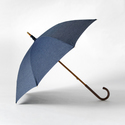
▲Men's Long Umbrella Wood Grain/Black
・Rain umbrellas are made from fabric with highly water-resistant waterproofing properties.
・Because the fabric doesn't allow air to pass through, if it isn't dried thoroughly after use, odors can become trapped.
・These are well suited for walking in the rain for extended periods or during heavy downpours.

▲All-Weather Folding Umbrella Stripe Organic Shade (Blue)
・These combine the functions of both a rain umbrella and a parasol, featuring both water-repellent (or waterproof) treatment and UV-cut treatment.
・In heavy rain, water may seep through the seams of the fabric.
・These are valued for their versatility—usable as a parasol on sunny days and as a rain umbrella on rainy days.
How to Use Your Umbrella
◆When You First Start Using It
First, be sure to remove the vinyl wrapping on the handle portion before use, as trapped water can cause it to deteriorate. If left on and used as-is, the film can lead to mold or damage.

▲Example of mold or damage (this can occur if the film isn't removed)
◆Precautions During Use
If you hold or rub the wet fabric of the umbrella with your hands, dirt and oils from your skin can transfer to the fabric and weaken its water-repellent (or waterproof) effect.
This effect is similarly weakened after applying hand cream or when your hands have a lot of natural oils on them, so try to avoid touching the fabric more than necessary.
◆How to Close and Neatly Fold Your Umbrella
When closing your umbrella, it's important to shake off water droplets first.Umbrellas are more resistant to front-and-back forces—like those used when opening and closing—than to side-to-side spinning motions, so point the umbrella diagonally downward and gently open and close it several times to shake off water droplets.(*Please avoid striking it against the ground to shake off water.)
Once you get home, be sure to dry it thoroughly before folding it up. If left wet for an extended period, it may develop wrinkles or begin to smell. Once dry, we recommend gradually tilting the umbrella body and slowly rotating it—without pulling hard on the fabric—then using the name band to bundle it while touching the fabric as little as possible.
How to Care for Your Umbrella
Since rain contains dirt and dust particles from the air, care should begin by rinsing away dirt with water before it has a chance to build up. After rinsing off dirt in the yard or bathroom, point the umbrella downward and repeatedly open and close it to thoroughly shake off water and let it dry.

If washing with water isn't possible, wipe the umbrella's surface and metal parts with a dry, soft towel, then leave it open to dry.

After lightly rinsing off overall dirt, dilute a neutral detergent in water (or lukewarm water) at roughly a 1-to-10 ratio and work it into a lather, then soak a sponge or towel with it and gently pat—rather than rub—the heavily soiled areas in a "tap-washing" motion.Afterward, rinse thoroughly and dry fully in a shaded, well-ventilated area.

How to Address Diminished Water Repellency (or Waterproofing)
When fabric soiling and deterioration become severe, it can be a sign that the water-repellent (or waterproof) effect has weakened. After cleaning, using a store-bought waterproofing spray or warming the fabric with a hairdryer to restore this effect is another way to extend the umbrella's life.
1. Always check and follow the instructions printed on the product before use.
2. Rinse off any dirt or debris from the umbrella's surface with water and let it dry completely. (*Do not use detergent.)
3.Wear a mask and ensure the area is well ventilated. Use the spray carefully in a location away from any open flame.
4. Depending on how the fabric reacts with the spray, staining may occur, so always test it on an inconspicuous area first.
5. Hold the spray about 20 to 30 cm or more away from the fabric and spray the waterproofing agent until the entire surface is evenly wet.
6. After spraying, wipe away any excess liquid that has pooled to prevent staining, and let the umbrella dry thoroughly in a shaded, well-ventilated area.

▲Be sure to wipe away any excess liquid that has pooled.

▲After drying for about 25 minutes, we poured water on it again in the same way, and even the areas where the fabric had absorbed water now formed beads that rolled off the surface of the umbrella. This confirmed that the water repellency was working effectively.
Please note that there are many different types of waterproof sprays, so be sure to check the ingredients, suitability for your material, and any precautions before use.
【Fluorine-based】Can be used on fabric items such as shoes and clothing. Compared to silicone-based sprays, the water-repellent effect doesn't last as long, so periodic reapplication is needed.
【Silicone-based】Can be used on leather goods. Not suitable for enamel, rubber, or materials that cannot be dry-cleaned.
【Natural-based】Can be used on smooth leather as well as napped leathers such as suede and nubuck. Many natural waterproof sprays don't contain chemical substances such as silicone or fluorine.
You can also restore water repellency by using a hair dryer. Hold it 5 to 10 cm or more away from the fabric while warming it. Overheating the fabric can cause the material or the ribs to deteriorate, so keep an eye on it and avoid warming it too much.

How to Store Your Umbrella After Use
If an umbrella is stored while still wet, the water-repellent (or waterproof) coating can weaken, and the ribs may rust, so it's important to dry the umbrella thoroughly after both use and maintenance. Direct sunlight and humid locations can cause deterioration and discoloration, soalways open the umbrella and let it air dry in a shaded, well-ventilated place.
Once dry, secure the umbrella with the name band before storing it. It's best to store it in a place with low humidity as well.

List of Umbrella Brands

ANATOLE PARIS (Anatole Paris)
ANATOLE PARIS (Anatole Paris) is a practical yet stylish umbrella brand born from the experience of its founder, David Kapikian, who spent his student days in England, where it rained almost every day and he felt he couldn't enjoy his own sense of style.
ANATOLE PARIS has also turned its attention to the problem of disposable umbrellas, pouring its passion into creating durable umbrellas that people will come to love, with the goal of eliminating overproduction and overconsumption. By choosing stylish, practical umbrellas, the brand proposes that people can enjoy comfortable rainy days while taking a step toward a more sustainable future.

KNIRPS (Knirps)
Knirps is the long-established brand that first created the folding umbrella in the world. The folding umbrella was invented in 1928 by Hans Haupt of Germany, and it was Knirps that first turned it into a commercial product a few years later. The folding umbrellas Knirps creates have captivated many people with their high quality, and even now, many years after its founding, the company continues to lead the way as a top manufacturer of folding umbrellas. In addition to its excellent functionality, Knirps has also earned high praise for its design, with the "X1" series winning the ISDA Award in 2004 and the Good Design Award in 2005. Perhaps it is this sincere pursuit of visual beauty alongside practicality that is the secret behind why Knirps umbrellas continue to be loved by people around the world for so long.

KOUMORIUMBRELLA (Koumori Umbrella)
KOUMORIUMBRELLA (Koumori Umbrella) is a brand that sees the umbrella not only as a practical item and fashion accessory, but also as a way to remind people to cherish their belongings, by conveying to those who hold one the value of an umbrella made using traditional techniques.
With a bold focus on making nothing but koumori-gasa (traditional bat-style umbrellas), the brand has perfected simple, timeless, basic umbrellas that let you fully appreciate the craftsmanship of skilled umbrella makers—a brand known for its beautifully refined, all-black umbrellas.

KOMIYA (Komiya)
When Komiya Shoten was founded in the early Showa era, the umbrellas commonly used by ordinary Japanese people were "bangasa"—umbrellas with bamboo ribs covered in oiled washi paper—while "yougasa" (Western-style umbrellas), with iron ribs and fabric such as silk or cotton, were luxury decorative items that only a select few could afford. It was in this environment that the founder, Komiya Hosho, began making Western-style umbrellas using koshu-ori, a textile from his home region of Yamanashi. This became the prototype for KOMIYA umbrellas. Ever since, the company has never been satisfied with the status quo, continually weaving in new, innovative techniques. Against this historical backdrop, KOMIYA umbrellas have been carefully preserved and passed down. Guided by the keywords "quality, trust, and innovation," the brand continues to create umbrellas that reflect the careful handiwork unique to skilled Japanese artisans—umbrellas that become lifelong companions you'll want to keep using forever.

ZUTTO (Zutto)
"We want to meet things we can keep loving for a long time," "We want to share the joy of that first encounter." ZUTTO is a select shop born from this very idea. As we introduce all kinds of "things"—items from Japan, items from around the world, things born from handwork, things that focus on materials, things that require skill—we sometimes find ourselves thinking, "It would be even better if something like this existed." Under the ZUTTO brand, we introduce original items made by pursuing that "even better" idea to its fullest.

hatsutoki (ハツトキ)
Born from the wish to "unravel the bolts of Banshu-ori fabric and convey, just as it is, the excitement of touching it for the first time," hatsutoki is a Banshu-ori (a traditional woven textile) brand from Nishiwaki City, Hyogo Prefecture—Japan's largest production area for cotton textiles. Using especially fine threads, hatsutoki crafts clothing from fabrics that pursue delicate coloring, bold color combinations, and a distinctive texture, achieving a melt-in-your-hand softness that feels nothing like ordinary cotton. The first time you touch it, you'll be surprised and moved, wondering, "Is this really cotton?"
We sense endless possibilities in hatsutoki's commitment to manufacturing products intended to be universal and cherished for a long time—what they call "wonderful basic"—as well as in the designs, which draw inspiration from everything the five senses can perceive in the surrounding natural scenery, colors, and sounds.

FOX UMBRELLAS
Founded in England in 1868, FOX UMBRELLAS has continued, since its founding, to make simple and beautiful umbrellas with an unwavering focus on quality and technique. In 1947, FOX UMBRELLAS, which had been manufacturing small parachutes, used leftover nylon from parachute production to develop the world's first umbrella made of synthetic fiber. The U-shaped steel frame that FOX UMBRELLAS devised became the standard framework structure used worldwide. The balance of its curved surface is calculated to gently receive falling rain and guide the water droplets away from the umbrella.
FOX UMBRELLAS is truly the brand that remains today as the originator of the umbrella.

Makita Shoten
Makita Shoten is a manufacturer of umbrella and clothing fabrics founded in 1866. Their fabric-making techniques stand far above the rest of the industry, and the patterns of their yarn-dyed jacquard weaves have excellent color development, creating a three-dimensional feel and a sense of luxury. With umbrellas made from elegant Koshu-ori fabric, even the person holding the umbrella can enjoy the pattern.
An umbrella should not simply be a "thing" that shields you from rain and dew.
It should be "an umbrella that brings you joy just to own,"
"an umbrella that makes you look a little more stylish,"
and "an umbrella you want to treasure and use with care."
To make products become exactly that, Makita Shoten focuses on thinking through, creating, and delivering products and services that will truly satisfy customers.
Makita Shoten is a brand that conveys its dedication to making umbrellas meant to be cherished for a lifetime.

wakao
"Kasa Kobo WAKAO" was founded in 1938 (Showa 13) by umbrella craftsman Sadamasa Wakao.
At the time, Tokyo was a major production center for umbrellas, but today it is one of the few remaining rare Japanese umbrella workshops. Maintaining an unwavering commitment to selecting each material, the workshop's skilled artisans carefully carry out dozens of processes by hand, from cutting the fabric to intermediate stitching, framework assembly, handle attachment, and finishing. Rather than making umbrellas as mere tools, they focus on crafting umbrellas meant to be cherished for a lifetime—prioritizing lightness, durability, a beautiful form whether open or closed, and an overall well-balanced harmony.
GUIDE »
CATEGORIES »
- + Gifts by recipient
- + Gifts by scene
- + Clothing
- + Bags / Backpacks
- + Wallets / Card cases
- + Jewelry
- + Shoes
- + Rainy day outfits
- + Kitchen
- + Home
- + Babies / Kids
- + Japanese products
Earn Miles

Payment & Security